

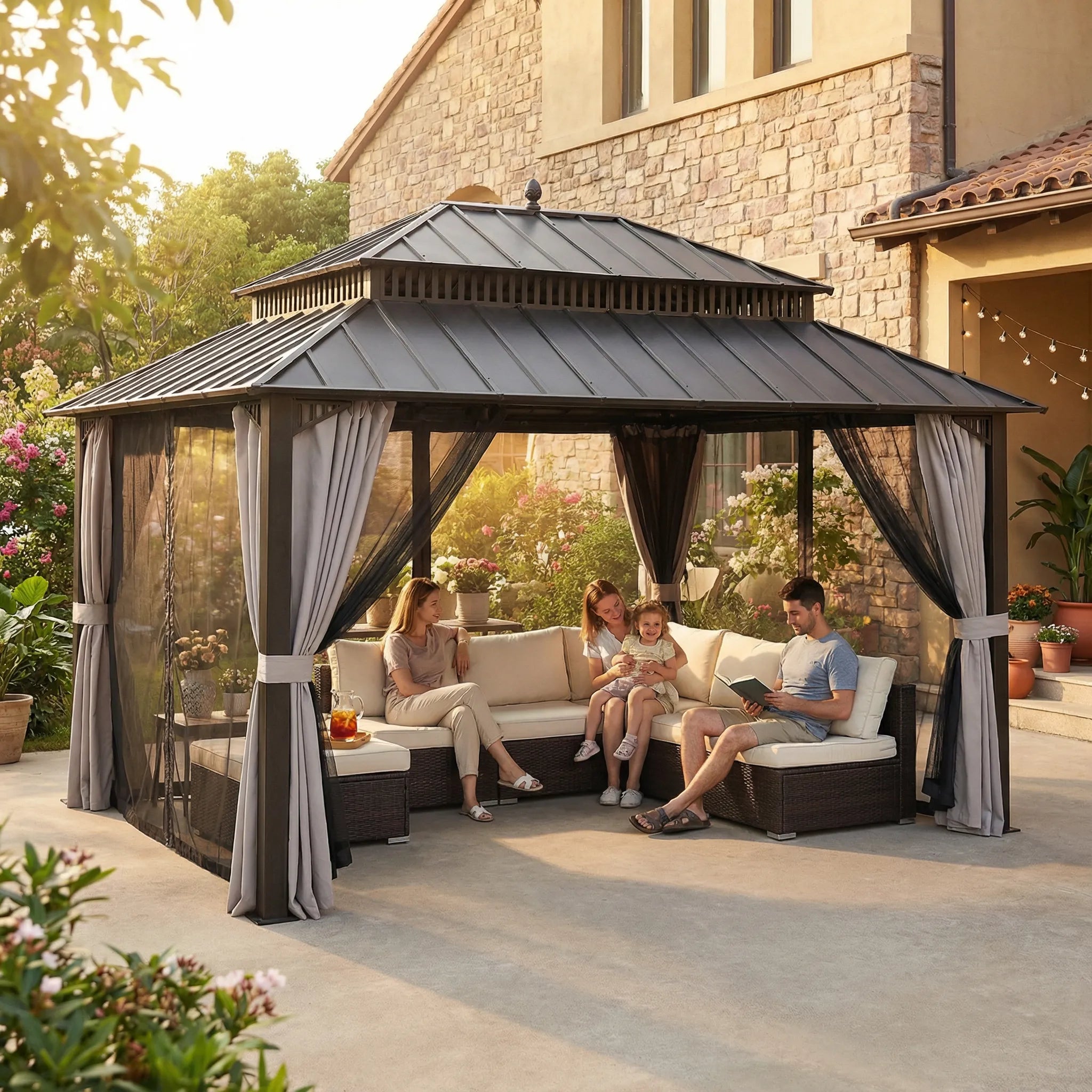

A gazebo can have a good roof and comfortable furniture yet still feel too exposed for everyday use. Afternoon glare, a neighbor’s window, or mosquitoes at dusk may be the reason you rarely sit there.
If you are deciding how to enclose a gazebo, start with that specific problem. Curtains can help create privacy and shade; mesh panels help keep insects out while preserving the view. You may only need to close one side during the afternoon and open everything again for an evening meal.
Before buying, check how the panels will fit, where guests will enter, and how much airflow you want. Those details matter more than making the gazebo look completely enclosed.
Choose an Enclosure That Matches Your Needs
Curtains for Privacy and Shade
Curtains work well when you want to soften direct sunlight or make a seating area feel more private. You can close the sides facing neighboring properties while leaving another side open for access and airflow.
Treat privacy and weather protection as separate purchasing questions. Fabric, seams, panel coverage, and attachments determine what a curtain can do. If rain protection matters, look for an explicit product claim and its limits rather than assuming that any outdoor curtain will keep the seating area dry.
Mosquito Netting for Airflow
Mesh panels are useful when insects are the main concern. Mesh generally preserves more visibility and airflow than solid curtains, making them a practical choice for warm evenings.
Protection depends on the complete installation. Open zippers, gaps around panel edges, or damaged mesh give insects a way inside. Netting provides limited privacy and does little to keep rain out.
Fixed Screens and Solid Panels
Rigid screens, glazing, and other fixed panels may change how wind loads affect the structure. They can also affect access, drainage, and local permit requirements.
Before making permanent changes, check with the gazebo manufacturer and the relevant local authority. A freestanding gazebo should not be assumed suitable for conversion into an enclosed room.
|
Enclosure |
Main benefit |
Important limitation |
Main check |
|
Fabric curtains |
Privacy and adjustable shade |
Weather resistance varies |
Model and attachment compatibility |
|
Mosquito netting |
Insect protection with airflow |
Limited privacy and rain protection |
Panel fit and zipper closure |
|
Fixed screens |
A more permanent insect barrier |
Requires suitable framing |
Structural and installation requirements |
|
Solid panels |
More separation from outdoor conditions |
Can substantially alter the structure |
Manufacturer approval and local rules |
Plan Which Sides Actually Need Coverage
Sketch the gazebo as viewed from above and mark the main entrance, seating, afternoon sun, and neighboring windows. This makes it easier to decide which panels you will usually close. For example, covering the side facing a neighbor may provide enough privacy while keeping the garden view open.
Check where tied-back fabric will sit before positioning furniture. A layout planned around everyday use is more useful than one that looks fully enclosed but makes the entrance awkward to reach.
Check Measurements, Model Numbers, and Hardware
A gazebo described as 10 by 12 feet does not necessarily accept every curtain set with the same size label. Roof dimensions, post spacing, rail height, and attachment details can differ between models.
Find the gazebo’s model number before shopping. It may appear on the original instructions, purchase record, or product identification label. Compare that number with the accessory listing rather than relying on appearance alone.
Next, measure the openings where the panels will hang. Record the distance between posts and the height from the attachment point to the intended lower edge. Check whether the product dimensions describe one panel, the complete set, or the gazebo itself.
Inspect the existing hardware as well. Some systems use hooks, rings, or dedicated tracks, and the number of attachment points matters. Confirm what comes with the replacement set and what must already be present on your gazebo.
Photograph the model label and existing attachment points before contacting the supplier. This gives the supplier a clearer basis for checking compatibility than a general description of the gazebo’s size or color.
SUNJOY Accessories for Specific Gazebo Models
When comparing accessories from SUNJOY, use the model information as the starting point. The following products serve different purposes and are intended for different gazebo models.
Replacement Curtains for the Asheville Gazebo — A111306202
This beige and dark gray curtain set is listed for the Asheville 10-by-12-foot soft-top gazebo, model A101007604.
- Includes a four-piece replacement curtain set.
- Combines beige fabric with dark gray accents.
- Fits the specified Asheville gazebo, model A101007604.
The listing explicitly excludes compatibility with other gazebo models. Matching the nominal footprint alone is not enough.

Replacement Mosquito Netting for the Windsor Gazebo — A111508200
This brown and khaki replacement netting is listed for the Windsor 10-by-12-foot gazebo, model L-GZ717PST-C.
- Includes four zippered mesh panels.
- Covers the four sides of the compatible gazebo.
- Does not include the metal frame or canopy.
These accessories fit different gazebo models, so they are not a matching curtain-and-netting set. Check each one against your gazebo’s model number.

Install Curtains or Netting Step by Step
Good preparation makes enclosing a gazebo easier and helps prevent damage caused by forcing an incompatible panel into place.
Prepare the Structure and Panels
Choose calm, dry conditions. Check that the gazebo is assembled, secured, and maintained according to its instructions before adding accessories.
Lay the panels on a clean surface and identify their orientation. Locate zippers, tiebacks, labels, and hanging points. Count the components against the accessory instructions before beginning.
If the gazebo frame, rails, or attachment points are damaged, address those problems first. Curtains should not be used to hide a loose connection or bent track.
Attach the Panels Without Forcing Them
Follow the installation sequence supplied for the specific gazebo and accessory. Use the designated attachment points, and do not drill new holes or modify structural parts unless the manufacturer allows it.
Keep the fabric supported while attaching it. Pulling a heavy panel from one corner can put unnecessary strain on the stitching or hardware.
Work around the gazebo methodically, checking that each panel faces the correct direction before moving to the next one.
Test the Complete Installation
Close the panels gently and check whether the zippers meet without excessive pulling. Open them again to confirm that they travel freely.
Look for fabric dragging across rough ground, mesh trapped against sharp edges, and tiebacks that interfere with entrances. Correct the cause rather than repeatedly forcing a zipper or stretching a panel.

Keep the Enclosure Comfortable and Well Maintained
An enclosure works best when you adjust it to the conditions. On a warm day, open selected sides to maintain airflow. For privacy, close only the panels that face the area you want to screen.
Avoid placing furniture so close to the panels that chairs rub against the material. Leave a clear route through the main opening, especially when guests are carrying plates or drinks.
Follow the accessory’s cleaning instructions. Do not assume every fabric can go into a washing machine or tolerate bleach. Start with the recommended cleaning method, and let the material dry completely before folding or storing it.
Check zippers, seams, and hanging points periodically. Small tears and loose fittings are easier to address before they become larger failures.
Weather planning matters too. Follow the manufacturer’s directions for opening, securing, or removing panels when conditions worsen. Do not assume leaving them closed is always the best choice.
At the end of the season, label stored panels with the gazebo model and keep their hardware together. Taking a few installation photos can make reassembly easier.
When enclosing a gazebo, start with the side or opening that causes the most discomfort. A compatible curtain set or mesh enclosure can make the gazebo more useful while preserving the option to open it up again. The right setup should fit both your gazebo and the way you use it.
Leave a comment
This site is protected by hCaptcha and the hCaptcha Privacy Policy and Terms of Service apply.